Average website redesign costs in 2026 and what impacts them
If you've started getting quotes for a website redesign, you've probably experienced a bit of shock. One agency quotes $3,000, another comes back at $15,000, and then you find specialist agencies charging $50,000 or more.
So, who's overcharging?
The truth is, probably no one.
Website redesign pricing varies so dramatically because no two redesign projects are the same. A five-page brochure website for a local business requires a completely different level of planning, design, website development and testing than a conversion-focused website built to generate leads for a growing business.
Unfortunately, many agencies simply advertise "website redesign" as though it's a single product. It's a bit like asking, "How much does a house renovation cost?" Without understanding the size of the project, your goals, or what's involved, no one can really give you an answer.
...But we're going to at least try to bring a bit of transparency to the conversation.
Whether you're planning a simple refresh or a complete rebuild, understanding what drives website redesign cost helps you make a smarter investment and avoid paying for things you don't need, or worse, paying twice because the first redesign didn't achieve your business goals.
In this guide, we'll talk through the average website redesign costs in 2026, explain what influences pricing, and show why the cheapest option isn't always the most cost-effective.
Average website redesign costs in 2026
As a general guide, these are the typical investment ranges for professionally managed website redesign projects in 2026.
Website Type | Typical Investment (USD) |
|---|---|
Small business/start-up website | $3,000–$6,000 |
Established business website | $6,000–$15,000 |
Bespoke business website with some custom work | $15,000–$40,000 |
Enterprise website | $40,000–$150,000+ |
It's important to remember that these figures are an average cost, not fixed prices. Two businesses could both require a "website redesign" yet receive quotes that differ by tens of thousands of dollars because their requirements are completely different.
Rather than asking "What's the average website redesign cost?", a better question is:
"What type of website does my business actually need?", with this, you can get a better idea of how much your website redesign will cost.
Small business/start-up website redesign ($3,000–$6,000)
This price range typically suits businesses that to show-up online, but that don't need custom features. It's also great for start-ups that are testing coming to market.
Common examples include:
Local service businesses
Consultants
Trades
Small professional firms
New businesses
Personal brands
A project at this level might include:
1-7 pages
Mobile-responsive web design
Basic SEO optimisation
Contact forms
Standard service pages
Simple blog integration
Updated branding
Improved user experience
For many businesses, this is all that's needed. If your website's primary purpose is to establish credibility and generate enquiries, there's often little value in paying for advanced functionality you'll never use.
However, businesses expecting significant lead generation or rapid growth may quickly outgrow a basic website.
Established business website ($6,000–$15,000)
As businesses grow, their website usually becomes one of their most valuable sales and marketing assets.
Instead of simply showcasing services, the website is expected to:
Generate qualified enquiries
Support digital marketing campaigns
Rank well in search results
Capture leads
Integrate with CRM systems
Improve conversion rates
Projects within this budget often include:
More bespoke web design
Improved information architecture
Additional landing pages
Conversion-focused layouts
Blog migration
Technical SEO improvements
Better mobile performance
CRM or email marketing integrations
Faster page speeds
At this stage, you're no longer paying just to exist online. You have real customers, real turnover, and you need a website that supports your revenue as well as your day-to-day operations.
Bespoke business website ($15,000–$50,000)
At this level, businesses are typically looking for more than a professional online presence. They often require a website that's tailored to their unique processes, customer journeys and growth plans, with a greater level of customisation than a standard business website.
Projects in this price range usually involve more advanced planning, bespoke design and functionality, rather than relying on existing templates or off-the-shelf solutions.
A bespoke website redesign may include:
In-depth discovery workshops
Competitor analysis
Customer journey mapping
Custom UX design
Bespoke user interfaces
Landing page strategy
Conversion rate optimisation
Performance optimisation
Advanced integrations
SEO migration planning
Extensive quality assurance and testing
At Greenlights, every website we build is designed with user experience and conversion in mind. As projects become more bespoke, the level of strategic planning, research, custom functionality and technical complexity naturally increases, which is reflected in the investment.
Rather than simply giving your website a new look, a bespoke redesign creates a digital platform that's built around your business, your customers and your long-term goals. For organisations that rely on their website to generate leads or drive revenue, this additional investment often delivers significantly greater long-term value than a more straightforward redesign.
Enterprise website redesign ($50,000+++)
Enterprise redesigns are fundamentally different from standard business websites.
These projects often involve:
Hundreds of pages
Multiple product or service categories
International SEO
User accounts
Customer portals
Complex integrations
Multiple stakeholder approvals
Accessibility compliance
Advanced security requirements
Bespoke functionality
Think about companies like Salesforce, HubSpot, or Adobe. Their websites aren't simply marketing brochures, they're complex digital ecosystems serving multiple audiences around the world. They need to showcase hundreds of products and resources, support customer logins, integrate with numerous business systems, deliver content in multiple regions and languages, and maintain high levels of performance, security and accessibility.
While most businesses won't require a website of this scale, these examples illustrate why enterprise redesigns command mean higher investment. At this level, the project is as much about digital transformation as it is web design. Planning, project management, technical architecture and stakeholder management often account for a substantial proportion of the overall project cost.
Why do website redesign costs vary so much?
One of the biggest misconceptions in the industry is that websites are priced based purely on the number of pages.
In reality, page count is just one small part of the equation.
When Greenlights scopes a website redesign, we look at the bigger picture:
What are your business goals?
Who are your customers?
How does your current website perform?
What's stopping visitors from converting?
Where are opportunities to improve the user journey?
Those answers determine the level of strategy, design and development required, not an arbitrary price per page.
That's why comparing two website redesign quotes without understanding what's included is almost impossible. One proposal might cover little more than a visual refresh, while another includes user research, conversion rate optimization strategy, SEO migration, custom functionality, analytics, testing and post-launch optimisation.
On paper, both are described as a "website redesign." In practice, they're completely different products.
So, what actually impacts the price?
If you've ever received two vastly different quotes for what appears to be the same project, you're not alone.
The reality is that a website redesign isn't a standard product with a fixed price. It's a bespoke service, and the cost depends entirely on what your business needs to achieve.
At Greenlights, we don't estimate projects based on guesswork or charge a flat rate per page. Instead, we assess the scope of the project, your business objectives, and the level of strategy, design and development required to deliver a website that supports measurable growth.
Here are the biggest factors that influence the cost of a website redesign.
1. Website size
This is one of the main things that will impact the cost of your website redesign. As you can imagine, designing and building a 3-page site will take a lot less time than a 30 page site. And time = money.
Every page needs to be designed, (maybe) rewritten, edited, developed, quality checked, and then tested across different devices.
Larger websites also require significantly more planning around navigation and information architecture. As websites grow, it becomes increasingly important to organise content in a way that helps users quickly find what they're need while also supporting your SEO optimization. And this takes time, too.
2. Website content
When we talk about size, we don't just mean the number of pages. The amount of content those pages have can also make a big impact.
Imagine two websites, each with ten pages.
The first contains around 300 words per page, a few images and a contact form.
The second contains over 2,500 words per page, FAQs, comparison tables, downloadable guides, embedded videos, testimonials, pricing sections and multiple calls to action.
While the page count is identical, the second website requires considerably more work to design, structure and optimize.
Long-form content affects:
UX design
Layout planning
Mobile responsiveness
Content migration
Internal linking
SEO optimisation
Quality assurance
This is often the case when redesigning a website for a business that has already invested in content marketing (/SEO). The pages are longer, the development is more complex, and all of this takes time to replicate.
3. Templates vs custom design
There are two main ways you can build a website, through templates (also called themes), or completely custom.
Template websites
Many lower-cost agencies begin with an existing template and customise it to match your branding.
This approach has some clear advantages.
Template websites are generally:
Faster to build
More affordable
Suitable for straightforward websites
Easier to launch quickly
For smaller businesses with relatively simple requirements, a template-based website can be a perfectly sensible solution.
However, templates also come with limitations.
Because they're designed to suit thousands of different businesses, they're rarely optimised for yours.
You may find yourself compromising on layouts, functionality or user experience simply because the template wasn't built around your business goals.
Templates can also include unnecessary code and features that negatively impact technical performance and Core Web Vitals, particularly if they're heavily customised over time.
Custom website design
A custom website starts with a blank canvas.
Rather than selecting a pre-built layout, every page is designed specifically around your business, your customers and your objectives.
This suits us at Greenlights, as we don't begin with colours or typography. We being with strategy.
We look at:
How visitors currently use your website
Where they're dropping off
Which pages generate enquiries
Which pages underperform
How users move through your buying journey
Only once we understand those behaviours do we begin designing.
The result is a website that's tailored to your audience rather than forcing your business into someone else's template.
While custom website design requires a greater investment, it provides significantly more flexibility, stronger branding, and improved user experience. It means your website is already set up to grow alongside you.
4. Integrations and custom functionality
A custom website doesn't automatically mean custom functionality. This is another factor you need to budget for, if it's business-essential.
Some businesses have operational requirements that can't be met with standard plugins or off-the-shelf software. That's where custom functionality comes in.
For example, you might need:
A customer order portal where clients can view invoices, place repeat orders or manage subscriptions
A bespoke package tracking system integrated with your logistics provider
A custom quotation or pricing calculator based on your products or services
An online booking platform with unique scheduling rules
A secure client dashboard for accessing documents or project updates
A property search tool for an estate agency
A vehicle configurator for an automotive business
A custom product builder that allows customers to personalise their order before checkout
Equally, many businesses need their new website to communicate with the software they already use every day.
Common integrations include:
CRM platforms such as HubSpot or Salesforce
Booking systems
Payment gateways
Live chat software
Recruitment platforms
Marketing automation tools
Inventory or ERP systems
Analytics and reporting software
While these features can transform the user experience and streamline internal processes, they also add complexity to a website redesign. Every integration must be carefully configured, tested and quality assured to ensure data flows correctly between systems and provides a seamless experience for both your team and your customers.
The important thing to remember is that custom functionality should always solve a genuine business problem, not simply be added because it's technically possible. Or because your web design agency are trying to upsell you.
During the discovery phase, we'll work with you to understand your operational requirements and recommend solutions that genuinely add value, ensuring you only invest in functionality your business will actually benefit from.
5. SEO migration
One of the biggest mistakes businesses make during a website redesign is focusing entirely on the visual design while overlooking search engine optimization.
A redesign changes far more than how your website looks. New URLs, updated navigation and restructured content can all affect how search engines understand your site.
Without a proper SEO migration strategy, businesses risk losing valuable rankings and organic traffic almost overnight.
A professional website redesign should include:
URL mapping
301 redirects
Metadata migration
Internal linking reviews
Schema implementation
Technical SEO checks
Crawl testing
Google Search Console validation
Performance optimisation
This work often happens behind the scenes, but it's one of the most important parts of any successful redesign. A website that looks fantastic but disappears from Google isn't a successful project.
Other costs to budget for
When planning a website redesign, it's important to look beyond the initial build cost.
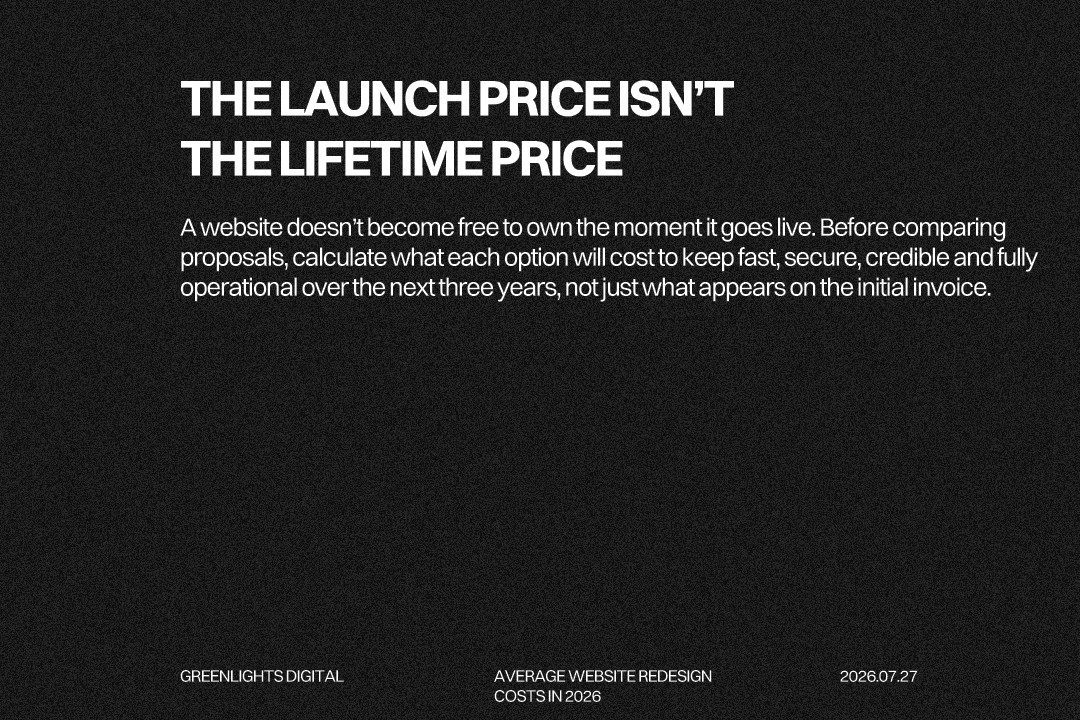
Your website is a long-term business asset, and like any other business investment, there are ongoing costs associated with keeping it secure, reliable and performing at its best.
Not every website will require all of the items below, but it's worth understanding what may need to be included in your overall budget, otherwise they might end up being hidden costs you weren't expecting.
Website hosting
Hosting is where your website lives online.
The quality of your hosting has a direct impact on page speed, reliability, security and uptime. While budget hosting may seem attractive, it can often result in slow load times, reduced performance and limited support.
For businesses that rely on their website to generate enquiries or sales, investing in reliable hosting is usually money well spent.
Domain name
Your domain name (for example, yourbusiness.com) needs to be registered and renewed each year.
If you're redesigning an existing website, you'll usually keep your current domain. However, if you're launching a new business or rebranding, you'll also need to budget for purchasing and maintaining a new domain.
SSL certificate
An SSL certificate encrypts data between your website and its visitors, helping to protect sensitive information and displaying the familiar padlock icon in a user's browser.
Many hosting providers now include SSL certificates as part of their packages, while others charge separately.
Regardless of how it's provided, every modern business website should have SSL protection. More on what is an SSL certificate and how does it work here.
Website maintenance
Launching your website isn't the end of the journey.
Like any software, websites require ongoing maintenance to keep them secure and performing correctly.
This can include:
Software and plugin updates
Security monitoring
Bug fixes
Performance optimisation
Backups
Uptime monitoring
Content changes
Compatibility testing
Without regular maintenance, websites can become vulnerable to security issues or gradually lose performance over time.
Premium plugins and software licensing
Many websites rely on third-party tools to provide additional functionality.
Examples include:
Form builders
Booking systems
SEO software
Security platforms
Premium page builders
Marketing automation tools
Cookie consent platforms
While some plugins are free, many operate on annual licence fees, which should be factored into your long-term website budget.
Photography and stock imagery
Professional imagery can make a significant difference to the quality of your website. While stock photography from websites like Shutterstock can be useful for filling gaps, it may involve additional licensing costs. Wherever possible, we strongly recommend using authentic photography of your team, premises, products and services. Original imagery helps build trust, reinforces your brand identity and creates a far more genuine connection with potential customers than generic stock photos ever could.
What about conversion optimized websites?
Not all website redesigns are created with the same objective.
Many agencies focus on delivering a website that looks modern, reflects your brand and meets the brief. Whilst there's nothing wrong with that, it doesn't always deliver the best return on investment.
At Greenlights, we operate a little differently.
We believe your website should be one of your hardest-working sales tools. Every decision we make, from the structure of a page to the wording of a button, is designed to encourage visitors to take action.
That means we don't just redesign websites. We redesign the entire customer journey.
Instead of asking "Does this look good?", we ask questions like:
Does this page answer the visitor's questions?
Is there a clear next step?
What's preventing someone from making an enquiry?
Are we building trust at the right moments?
How can we reduce friction throughout the buying journey?
The result is a website that's designed to generate measurable business results (whether that's sales, signups, subscriptions, or something else).
Standard websites vs CRO optimized websites
The easiest way to understand the difference is to compare the priorities behind each approach.
Traditional Website | Greenlights CRO Website |
|---|---|
Designed to look modern | Designed to generate enquiries and sales |
Focuses on visual design | Focuses on user behaviour and conversion |
Standard page layouts | Pages built around customer journeys |
Generic calls to action | Strategically placed conversion opportunities |
Launch is the finish line | Launch is the beginning of optimisation |
Success is based on appearance | Success is based on business performance |
How to know if your website redesign is worth the investment...
Do not get distracted with how your website looks. Deciding whether a website redesign is worth it is all about setting objectives before the project even begins.
Those objectives will be different from business to business.
For new businesses
If you're designing a website for a new business, success is actually pretty straight forward.
Your website needs to:
Establish a professional online presence
Clearly communicate your products or services
Build trust with potential customers
Reflect your brand professionally
Make it easy for people to get in touch/buy/etc.
At this stage, whilst you're still setting up shop, simply having a well-designed, credible website can be enough to support your business goals.
For established businesses
As your business grows, your website should grow with it.
So ask yourself "Why are we redesigning the website?"
If the answer is simply "because it looks old," you're probably not thinking big enough.
Instead, try to think in terms of numbers.
For example, you may want to:
Increase qualified enquiries by 30%
Improve conversion rates on key landing pages
Reduce bounce rates
Increase average time on site
Improve organic search visibility
Generate more online sales
Reduce friction in your customer journey
Better support your sales team
Having clear objectives from the outset allows you to measure whether your investment has actually delivered value.
Setting goals before you get going
One of the biggest mistakes businesses make is deciding how successful a redesign was based purely on appearance.
A modern-looking website is great, but if enquiries stay the same, conversion rates don't improve and organic traffic declines, was the project really a success?
At Greenlights, we encourage clients to define success before any design work begins.
That might include KPIs such as:
Enquiries generated each month
Conversion rate
Organic traffic
Revenue generated through the website
Average engagement time
Form completion rates
Lead quality
Return on investment
By establishing clear benchmarks before the project starts, you can compare performance after launch and understand exactly what's improved.
Ready to invest in a website that delivers results?
A website redesign isn't just an opportunity to modernise your online presence, it's an opportunity to rethink how your business attracts, engages and converts customers.
At Greenlights, we don't believe in redesigning websites just so they look a little prettier. Every project is built around strategy, user experience and conversion rate optimisation, helping ensure your website becomes a genuine driver of business growth.
If you're considering a website redesign and want to understand what your business actually needs, not just what it might cost, we'd love to help.
Get in touch with our team for a free consultation, and we'll review your current website, discuss your goals and design you a free homepage demo so you can see our ideas live.
FAQs
Can my current site be improved instead of building a new one?
In some cases, your current site may only need design updates or technical improvements. However, if it's difficult to update, performs poorly or no longer supports your business goals, investing in a completely redesigned site is often the more cost-effective long-term solution.
Why do some web agencies charge higher rates than others?
Agencies that charge higher rates often provide far more than visual design. Strategic planning, user research, SEO migration, conversion rate optimisation, quality assurance and ongoing support all require specialist expertise. It's important to compare what's included in each proposal rather than looking at price alone.
Will a new design automatically improve conversions?
Not necessarily. A new design may make your website look more modern, but better business results come from combining attractive design with a stronger UX, clear calls to action and a website that's built around your customers' needs and behaviours.
Why do website redesign quotes vary so much?
No two projects are the same. Factors such as project complexity, the number of pages, custom functionality, integrations, content migration and SEO requirements all influence the overall cost. That's why two websites that appear similar on the surface can have very different project budgets.