INSIGHTS
What is generative engine optimization?

For nearly two decades, traditional search engines have shaped how people find information online. Users typed a query, scrolled through search results, clicked a few blue links and pieced together answers themselves.
Now, though, the rise of generative AI has completely changed that behavior. Instead of browsing multiple web pages, soaking up various pieces of information, users now expect direct, conversational answers delivered instantly by AI platforms like ChatGPT, Google Gemini, Claude and Perplexity.
This means there’s been a huge change in how information is discovered.
Search engines are no longer the only gateway to visibility, generative engines have entered the landscape as “answer engines,” pulling insights from across the internet and presenting them in natural language.
So, as users become more and more reliant on generative engines for their answers, businesses need to figure out how to be visible in this space.
Enter, generative engine optimization (GEO).
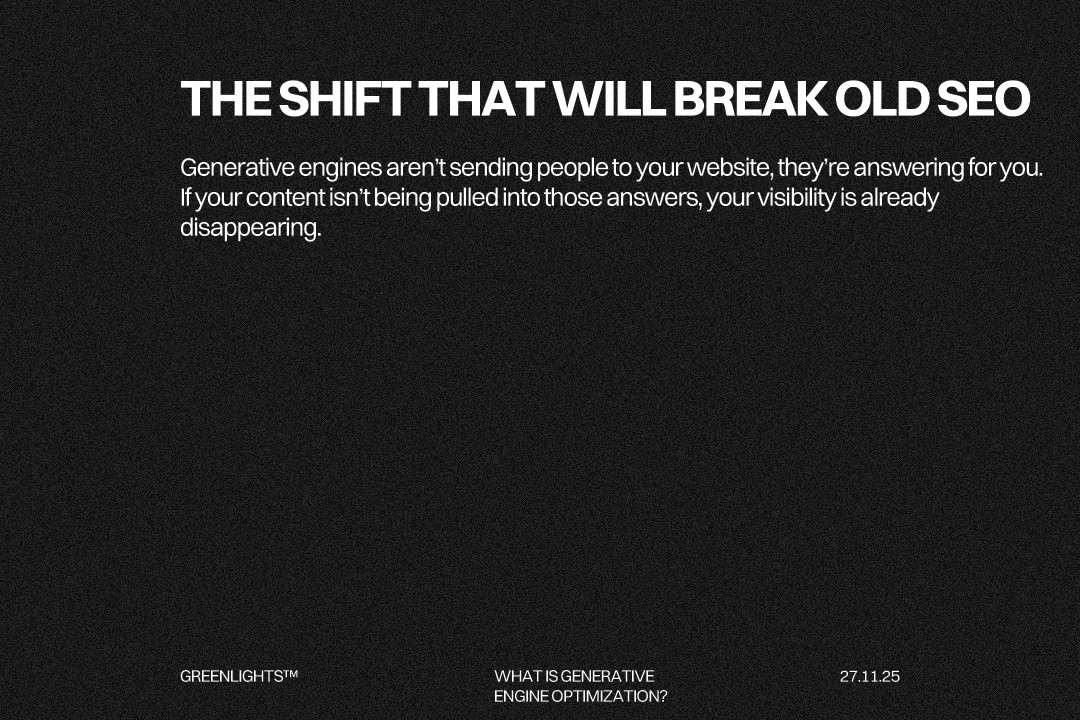
GEO is the SEO for AI. It’s the way to make your brand, products and expertise visible inside AI-generated answers, not just in traditional search results.
If traditional SEO was about ranking web pages, GEO is about ensuring AI engines can confidently use your content as a trusted source when answering users.
So, what is generative engine optimization exactly?
Generative engine optimization is the practice of improving your brand’s visibility inside AI search engines and generative results produced by systems like ChatGPT, Perplexity, Gemini, and other large language models (LLMs).
These generative engines don’t show ranked lists of links like traditional search engines. Instead, they analyze data points from across the web, interpret user intent, and deliver natural-language answers, based on everything they’ve digested. They will then cite their sources, and this is where you want to come in.
GEO aims to make your content the information AI engines rely on when generating answers.
Put simply:
SEO = Optimizing for search engines like Google.
GEO = Optimizing for AI engines and answer engines.
How does AI know what to cite?
Generative engines work differently from traditional search platforms. They evaluate content based on:
Clarity of information
Topical authority
How well the content aligns with user queries
How easy it is for language models to interpret
The relevance and structure of your website content
Whether your site is considered an authoritative source
GEO vs SEO: The differences
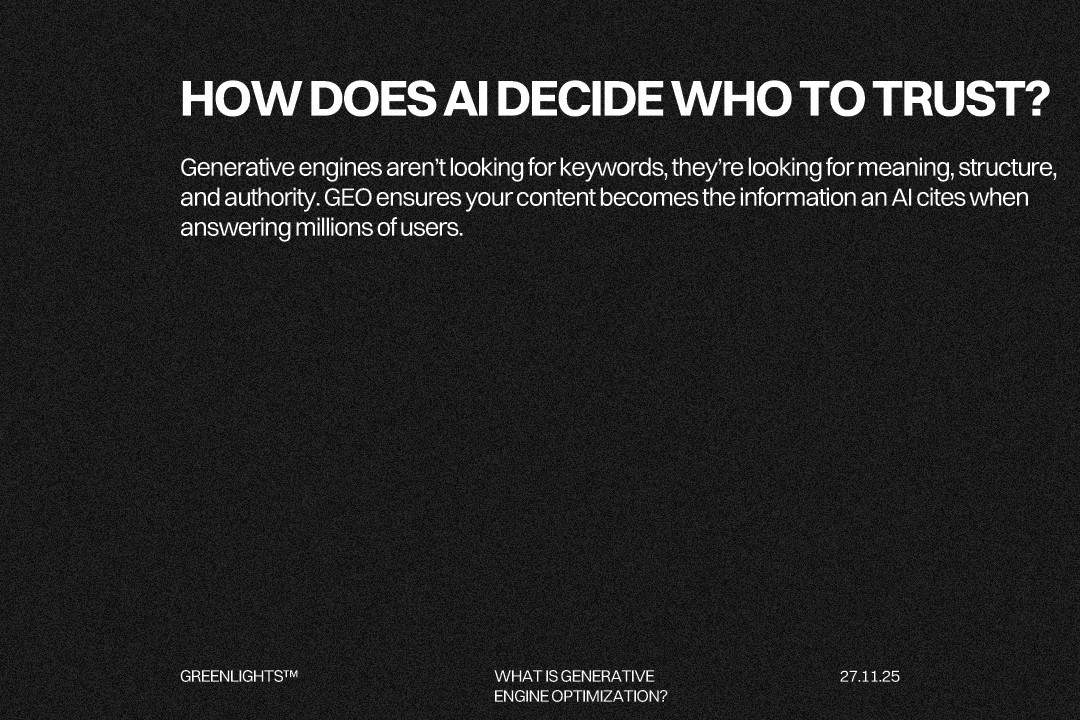
Traditional search engine optimization has always revolved around improving visibility in Google Search and similar platforms. The focus is on rankings, backlinks, keyword optimization, and presenting content that helps search engines crawl, index, and understand your web pages. In that world, the user browses the search engine results, chooses a link, and consumes the content themselves.
Generative engine optimization works differently because the destination is different. When a user asks an AI engine a question, they’re not scrolling through links, they’re receiving a direct answer created by a large language model. That means the AI becomes the middle layer between the user and your website content.
1. Rankings vs. answers
Traditional SEO aims to get you higher in search results. GEO aims to get you included in the answer itself, the AI’s generative output.
2. Keywords vs. natural language
Traditional SEO relies heavily on keyword placement. GEO focuses on natural language and how content aligns with user intent and conversational phrasing.
3. Crawlers vs. LLMs
Search engines use crawlers to index pages. Generative engines use LLMs that interpret information differently, prioritizing clarity, structure, and authoritative sources.
4. User behavior
In traditional search, users click through multiple pages to compare information. In generative AI, users want a single, finalized answer, your content needs to support that.
5. Content structure
SEO content can get away with being long and keyword-heavy. GEO requires clean structure, clear headings, and data points that LLMs can easily summarize.
6. Authority Signals
Traditional SEO uses backlinks as a primary authority metric. GEO expands this to include brand visibility across social media, forums, citations, and contextual mentions.
Ultimately, GEO doesn’t replace traditional SEO, but it changes the rules. If SEO helps search engines understand your content, GEO helps AI engines use your content.
How generative engines have changed user behavior
Search types
Generative engines fundamentally shift how people search online. Instead of typing short, keyword-style queries into traditional search engines, users now ask full, conversational questions. This aligns with how generative AI and large language models understand natural language, context, and intent, not just keywords on a page.
In traditional search, someone might type:
With GEO, they might ask a tool like ChatGPT
“Which web development company in Poole is best for my small plumbing business”
This shift means your website content must mirror these natural language queries. It needs to answer specific topics, user questions, and multi-intent prompts, not just rank for isolated terms.
The list of links model
Generative engines don’t force users to scroll through pages of search results. Instead, they give a consolidated, personalized answer. This means, users get an answer faster, there’s not so much need for click-through, and websites that don’t provide useful, structured, authoritative information risk being excluded from AI answers entirely
User intent
Search isn’t just about matching keywords now, it’s about understanding why someone is searching. Generative engines look at:
User behavior
Context
Previous queries
Location and geo strategies
Content depth
Data points across the web
Authoritative sources
To show up in AI results, your website must satisfy intent clearly and thoroughly.
Why GEO matters
Generative engine optimization doesn’t replace traditional SEO, it builds on it. GEO takes the foundation of search engine optimization and adapts it for a landscape where AI platforms and answer engines are going to become the primary source of information for people browsing on the internet.
Think of GEO and SEO as overlapping circles:
SEO = helps you appear in search results
GEO = helps you be included in AI answers
Both = rely on relevant content, best practices, and strong digital strategy
To ensure you continue to appear online, you need to master both.
How generative engines use web content
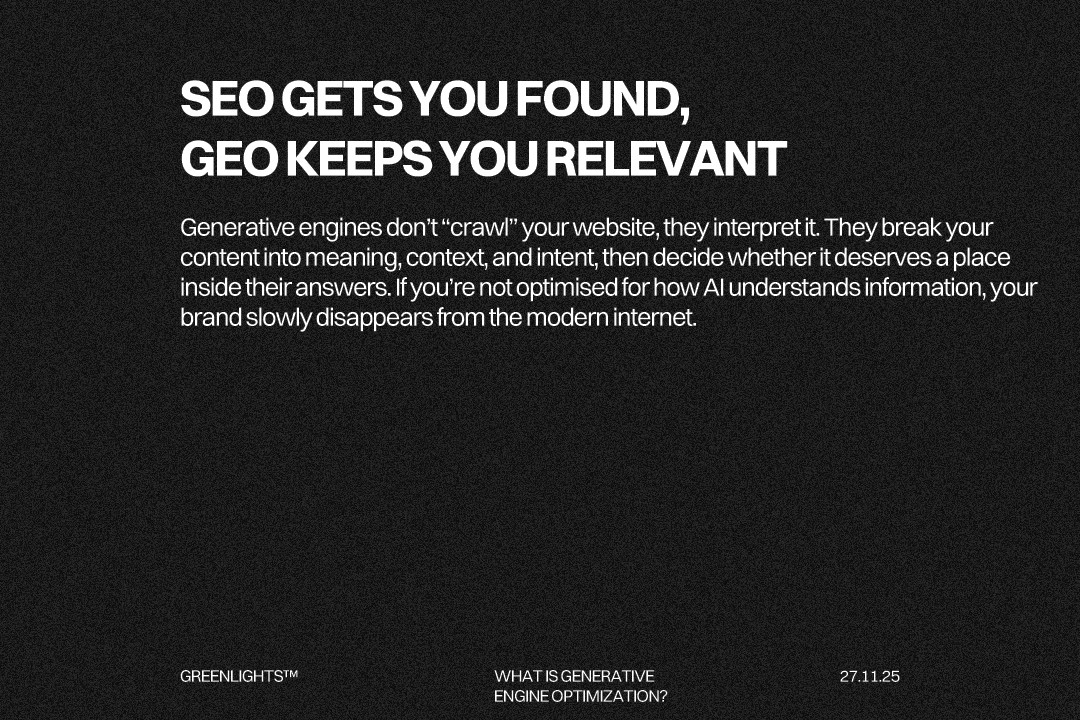
Generative engines don’t read web pages the same way traditional search engine algorithms do. They don’t index linearly or rely on simple keywords. Instead, they ingest your content, break it into data points, and analyze how well it answers user queries.
Where traditional engines use crawling and indexing, generative engines use:
AI pattern recognition
Language models
Semantic understanding
Contextual mapping
Topic clustering
This allows them to understand not just what you wrote, but what it means.
What content to write for GEO
Structured content makes it easier for AI engines to extract relevant parts. This includes:
Clear headings
Logical flow
Accurate subtopics
Schema markup
FAQ sections
Well-labeled data
Internal linking that supports topic depth
The goal is to make your quality content that’s “digestible” to artificial intelligence and natural language processing models.
Quality over quantity
AI platforms prioritize:
Authoritative sources
Depth of explanation
Factual accuracy
Relevance
Factual consistency
User-friendly formats
Keyword stuffing or thin content works even less in an AI-driven ecosystem. To appear in answer engines, your website must genuinely help people.
FAQ pages
FAQs have become one of the strongest assets for GEO. Generative engines love them because they:
Answer direct user questions
Use simple, natural language
Align with conversational search behavior
Provide clear, structured data points
FAQ pages should reflect the way people now speak to AI engines, that is in full-sentence queries rather than short keywords. When matched with good schema markup, they feed answer engines highly organized, comprehensive answers that it can cite.
How-to guides
Users increasingly rely on AI search to walk them through processes step-by-step. Instructional content excels in GEO because it:
Shows clear content structure
Demonstrates expertise
Covers specific topics in depth
Provides authoritative, useful explanations
Generative engines thrive on logical sequences, so how-to guides help LLMs confidently summarize instructions for search results.
“Vs” and comparisons
Pages like Product A vs Product B are extremely valuable because they mimic the type of user queries that generative engines frequently get asked. Try to write:
Comparisons
Best-of lists
Pros/cons evaluations
Alternative suggestions
These pages help AI platforms determine which option fits a user’s intent based on relevant content and practical distinctions.
Deep-dive Articles
AI search engines reward content that demonstrates genuine expertise. This includes:
Authoritative sources
Subject-matter insights
Data-driven analysis
Well-researched breakdowns
If you can prove to AI that you’re an expert, trusted source, your content is more likely to get cited.
Case studies and original data
One thing that’s not so different from SEO… nothing improves AI visibility more than unique data.
Case studies and proprietary insights give generative engines information unavailable elsewhere, increasing the chance that your content appears in search platforms and AI answers. Think about how you can use your blog posts and content marketing strategy to put NEW content out into the world, something that no one else has written yet!
Topic-specific pages
Generative engines prefer pages that cover a specific topic thoroughly, not vague, catch-all articles. Focused pages help generative AI determine relevance more accurately, improving search rankings and brand visibility across both traditional search engines and AI search engines.
How to write content for GEO
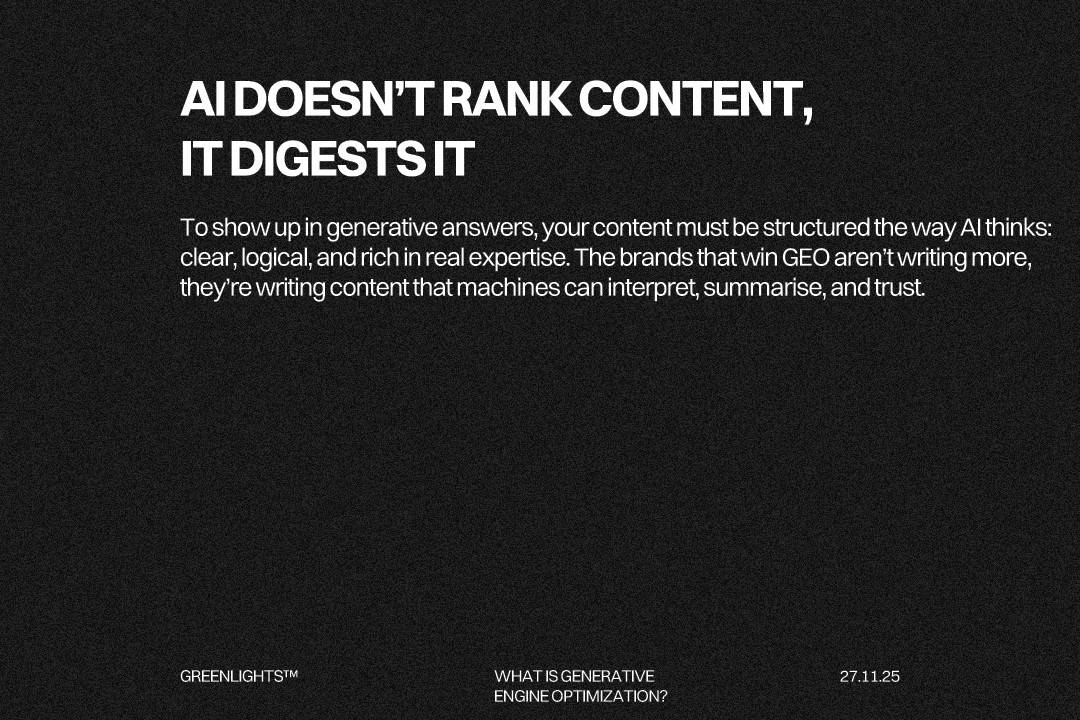
To optimize for generative engines, your content must be easy for large language models to interpret, summarize, and repurpose into answers. That requires moving away from worrying about keyword density. Instead, think about writing structured, helpful, natural content.
Use simple language
Generative engines work best when content is:
Clear
Concise
Logically organized
Free from unnecessary jargon
Simple writing improves comprehension for both human readers and AI engines. GEO leans heavily on conversational language. This means writing as if you’re answering a real question, not forcing keywords into sentences. Natural language helps generative engines identify meaning, context, and relevance.
Make content scannable
AI search engines favor content that’s easy to break into data points. Use:
Headings
Bullet points
Tables
Short paragraphs
Concise summaries
This structured content is more likely to appear in generative answers within search results.
Answer questions
Generative engines prefer content that gets straight to the point. Each page should answer a specific user question quickly and thoroughly, with relevant information delivered upfront.
Don’t forget humans
To ensure your content is LLM-friendly, focus on:
Clear definitions
Topic-focused sections
Step-by-step frameworks
Authoritative explanations
Semantic clarity
Well-labeled elements (e.g., schema markup where appropriate)
Your goal is to help AI platforms understand exactly what your content means so they can present it confidently as a generative answer.
Prompt research: The new keyword research
As generative engines become the main way for website traffic to get answers, prompt research is replacing traditional keyword research. Instead of analyzing short search phrases, brands must now understand the questions, commands, and conversational prompts users give to AI engines.
Prompt research identifies:
How users phrase questions in natural language
What generative engines frequently misunderstand
Which topics require clearer or more authoritative content
The structure of real user queries
Understanding prompt research will help guide your digital strategy. It helps you understand what kind of content you should be creating, to improve your chances of getting cited.
Local GEO strategies
Generative engine optimization is especially powerful for local SEO and GEO strategies because AI search engines increasingly personalize results based on location. Instead of showing a list of links, they deliver conversational, context-aware answers, so it’s essential that local business position themselves right in the AI search landscape.
Generative engines consider:
Local intent in user queries
Proximity
Relevance of website content
Unique local expertise
Specific topics tied to regions or neighbourhoods
If your content doesn’t explicitly reflect this local relevance, AI platforms may not surface your business in search engine results.
Create localized pages
Examples include:
“Best web development company in Poole: How to choose”
“How much does web development cost in Bournemouth“
These pages give AI engines the precise, localized data points they need to recommend businesses.
Use local schema markup
Schema markup remains essential. It helps AI engines:
Confirm your address
Understand your service area
Verify opening hours
Validate authoritative sources like reviews
This structured data supports both traditional search engines and modern AI search.
Offer local expertise
Generative engines favor businesses that provide:
Unique data
Locally relevant information
Case studies
Neighborhood-specific tips
Region-specific best practices
This boosts brand visibility in AI search engines where simple lists of links no longer dominate.
AI and authority in the GEO era
Generative engines evaluate authority differently from traditional search. Instead of relying primarily on backlinks and domain metrics, AI engines focus on clarity, originality, and depth, specifically the signals that help large language models trust your content.
AI platforms value:
Expert explanations
Detailed content structure
Step-by-step guidance
Well-defined concepts
Precise, relevant information
Generative engines prefer content that reads like it was created by someone who truly understands the subject. Signals of expertise include the use of original data, case studies, firsthand insights, practical examples, and unique opinions. Hiring content creators that are focused on a niche will really help you rank, both in SEO and GEO.
Final tip: Ensure content is crawlable
All of this work isn’t going to help you if your site is blocked from AI engines. Some sites need specific permission to crawl your content. Avoid unintentionally blocking them in robots.txt if you want visibility in generative engines.
The future of GEO: What’s coming next
While Google is still the main source of all truth, and all search queries, generative engine optimization is quickly changing the landscape of digital marketing. Businesses that prepare now will have an enormous advantage as AI search becomes the dominant discovery tool.
1. Answer engines will replace SERPs
Traditional search engines will shift toward:
Conversational answers
Summarized explanations
Contextual suggestions
Human-like responses
Users will receive fewer lists of links and more direct solutions.
2. Strong authority will matter even more
LLMs will want expert-led content and high quality explanations. It’s important to use credible sources, well-structured pages, and consistent topic coverage so you can position yourself as a thought leader and expert. Plus, content that reads like it was written by a real expert, not for algorithms, will dominate.
3. GEO and SEO will merge
The future of SEO isn’t one or the other, it’s both. Businesses must optimize for:
Google Search
AI engines
Answer engines
Social conversation models
This multi-channel approach is essential for content relevance and search visibility.
Read more





Bethany
Conversion Strategist